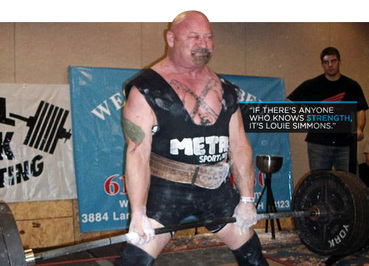
By: Louie Simmons
When lifters repeatedly use the same simple method of training to raise their strength level, they will eventually stall. Like the scholar who must utilize many sources of information to achieve a higher level of knowledge, the lifter must incorporate new and more difficult exercises to raise their standards. Many have the theory that to squat, bench, or deadlift more, you simply have to do the three lifts. If it were that simple no one would need special exercises, machines, or systems of training. But we know this is not true.
Because lifters have different body types, they may excel at one lift but struggle with another. The great Lamar Gant was the only lifter I have known who held the world record deadlift and bench at the same time. There are men who hold three world records in the deadlift, yet can’t make the top 10 bench list. Their muscles in the upper body are, I’m sure, as strong as anyone’s, but they are limited by body structure, e.g., short torso, long arms. Many of us are affected by this. But is there an answer?
In the early 1970s, the Dynamo Club in the former Soviet Union had 70 highly skilled Olympic lifters. They were introduced to a system of 20-45 special exercises that were grouped into 2-4 exercises per work-out and were rotated as often as necessary to make continuous progress They soon found out that as the squat, good morning, back raise, glute/ham raise, or special pulls got stronger, so did their Olympic lifts. When asked about the system, only one lifter was satisfied with the number of special lifts; the rest wanted more to choose from. And so the conjugate system was originated.
When you have a body type that lacks say, the muscles that squat and yet you squat on a regular basis, then a coupling of special exercises for the glutes, hamstrings, hips, and lower back are needed to fortify those areas. These special exercises will en-able you to raise your squat once more.
Think about it if you read only one book, no matter how many times you read it, you will only learn so much. If you only squat, you will get only so strong because no new stimulus is introduced. This may not happen in the early stages of training, but as you become more advanced, you will need a more strenuous method of training. This training will indeed help your motor potential and help you to perfect your technical skill.
When lifters repeatedly use the same simple method of training to raise their strength level, they will eventually stall. Like the scholar who must utilize many sources of information to achieve a higher level of knowledge, the lifter must incorporate new and more difficult exercises to raise their standards. Many have the theory that to squat, bench, or deadlift more, you simply have to do the three lifts. If it were that simple no one would need special exercises, machines, or systems of training. But we know this is not true.
Because lifters have different body types, they may excel at one lift but struggle with another. The great Lamar Gant was the only lifter I have known who held the world record deadlift and bench at the same time. There are men who hold three world records in the deadlift, yet can’t make the top 10 bench list. Their muscles in the upper body are, I’m sure, as strong as anyone’s, but they are limited by body structure, e.g., short torso, long arms. Many of us are affected by this. But is there an answer?
In the early 1970s, the Dynamo Club in the former Soviet Union had 70 highly skilled Olympic lifters. They were introduced to a system of 20-45 special exercises that were grouped into 2-4 exercises per work-out and were rotated as often as necessary to make continuous progress They soon found out that as the squat, good morning, back raise, glute/ham raise, or special pulls got stronger, so did their Olympic lifts. When asked about the system, only one lifter was satisfied with the number of special lifts; the rest wanted more to choose from. And so the conjugate system was originated.
When you have a body type that lacks say, the muscles that squat and yet you squat on a regular basis, then a coupling of special exercises for the glutes, hamstrings, hips, and lower back are needed to fortify those areas. These special exercises will en-able you to raise your squat once more.
Think about it if you read only one book, no matter how many times you read it, you will only learn so much. If you only squat, you will get only so strong because no new stimulus is introduced. This may not happen in the early stages of training, but as you become more advanced, you will need a more strenuous method of training. This training will indeed help your motor potential and help you to perfect your technical skill.
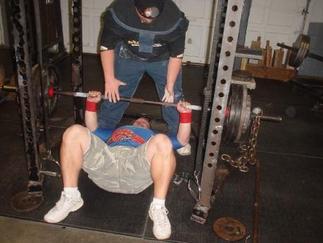
Before I present some examples of conjugate training, think about this. How much could you bench press the first time you tried? 200? 300 perhaps? Now how did you achieve that level of strength without ever having benched be-fore? You did it through simplified training such as pushups and pull-ups. Those of you who could bench 300 the first time will never double that amount without doing specialized work to raise your strength, right?
Here are some examples of the conjugate method. Glen Chabot bench presses only twice a month. Both times he uses a close-grip style He can do 405 for reps in the low teens. His best single close grip is 635 without a shirt. In between each workout, he rotates heavy dumbbell work on a flat or incline bench or very heavy bodybuilding exercises for lats, delts, pecs, and triceps.
This linking of special exercises has given Glen a 705 bench press at 275. Glen does not arch when he benches and has fairly long arms. He realized that he needed a special program to fortify his pressing muscles. This is a simple but very effective training program.
A more complex system is Kenny Patterson’s. He will do floor press, chain press, board press, incline press, and over-head press, just to name a few, rotating to a different- exercise each max effort day. On the dynamic day, Kenny uses three different grips on the bench press and uses 60% of his no-shirt max for 8 sets of 3 reps. He adds a lot of triceps extensions with dumbbells or the barbell, rows (one-arm, two-arm, chest-supported), pull downs, delt raises, and forearm work. This is a more complex system than Glen’s, but it suits Kenny’s needs. Kenny is a legitimate 700 bencher, having done it several times across the country.
Here are some examples of the conjugate method. Glen Chabot bench presses only twice a month. Both times he uses a close-grip style He can do 405 for reps in the low teens. His best single close grip is 635 without a shirt. In between each workout, he rotates heavy dumbbell work on a flat or incline bench or very heavy bodybuilding exercises for lats, delts, pecs, and triceps.
This linking of special exercises has given Glen a 705 bench press at 275. Glen does not arch when he benches and has fairly long arms. He realized that he needed a special program to fortify his pressing muscles. This is a simple but very effective training program.
A more complex system is Kenny Patterson’s. He will do floor press, chain press, board press, incline press, and over-head press, just to name a few, rotating to a different- exercise each max effort day. On the dynamic day, Kenny uses three different grips on the bench press and uses 60% of his no-shirt max for 8 sets of 3 reps. He adds a lot of triceps extensions with dumbbells or the barbell, rows (one-arm, two-arm, chest-supported), pull downs, delt raises, and forearm work. This is a more complex system than Glen’s, but it suits Kenny’s needs. Kenny is a legitimate 700 bencher, having done it several times across the country.
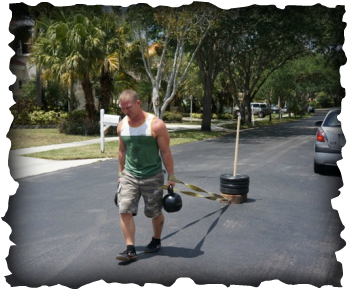
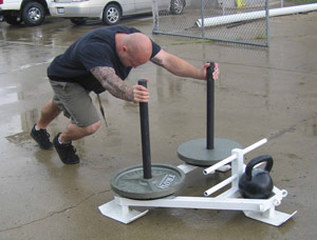
Mike Ruggiera and myself just made 900 squats. It was a 50 pound increase for him and a 40-pound increase for me, yet we did not do a single regular squat in between meets. We do box squats on speed days with a large amount of bands and weight. We also use the reverse hyper machine and do glute/ham raises, pull-throughs, and abs. I pull a weighted sled before my squat workouts.
On max effort day, we do good mornings (five varieties), belt squats, speed deadlifts (60% for 6-8 singles), and Safety Power Squat Bar squats to different box heights. Mike also pulled his first 800 deadlift, without having done any conventional squats and no big deadlifts. After squatting he does deadlifts for singles with 60% for speed, and three days later he maxes out on special work: this is the conjugate method.
To push up a squat, heavy good mornings or squatting with different bars is done on max effort day. The different bars make squatting very awkward and extremely hard to do, much harder than a regular squat. (The same is true of box squats; they are harder than competition squats.) On max effort day we may do a type of squat on week 1, a good morning on week 2. and a front squat on week 3, each exercise contributing to the next week’s exercise, which in turn will build a bigger squat by strengthening the weaker muscle group and perfecting form.
The training is linked together, enabling you to raise your total. For instance, to build the glute and hamstring area, push up your reverse hyper extensions as hard as possible until your progress slows. Move on to pull-throughs for a week or two, until progress in these slows as well. Then go to glute/ham raises, and again push as fast and hard as possible. Then pull a sled walking forward to build the glutes/hamstrings. It is possible to continuously gain strength in any body part by switching special exercises. As the effectiveness of the exercise decreases, switch to another one. By training in this manner, it is possible to raise all types of strength throughout the year.
On max effort day, we do good mornings (five varieties), belt squats, speed deadlifts (60% for 6-8 singles), and Safety Power Squat Bar squats to different box heights. Mike also pulled his first 800 deadlift, without having done any conventional squats and no big deadlifts. After squatting he does deadlifts for singles with 60% for speed, and three days later he maxes out on special work: this is the conjugate method.
To push up a squat, heavy good mornings or squatting with different bars is done on max effort day. The different bars make squatting very awkward and extremely hard to do, much harder than a regular squat. (The same is true of box squats; they are harder than competition squats.) On max effort day we may do a type of squat on week 1, a good morning on week 2. and a front squat on week 3, each exercise contributing to the next week’s exercise, which in turn will build a bigger squat by strengthening the weaker muscle group and perfecting form.
The training is linked together, enabling you to raise your total. For instance, to build the glute and hamstring area, push up your reverse hyper extensions as hard as possible until your progress slows. Move on to pull-throughs for a week or two, until progress in these slows as well. Then go to glute/ham raises, and again push as fast and hard as possible. Then pull a sled walking forward to build the glutes/hamstrings. It is possible to continuously gain strength in any body part by switching special exercises. As the effectiveness of the exercise decreases, switch to another one. By training in this manner, it is possible to raise all types of strength throughout the year.
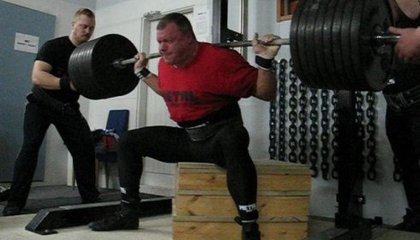
On max effort day the entire volume consists of unidirectional loading. One training workout contributes to the next. Keep in mind that if you train a lift at 90% or more for more than 3 weeks, your central nervous system is negatively and your progress will go backward. But by switching exercises each week (for the high-level lifter), you can use 100% and more each week. The sequence of exercises you use does not matter, as long as the load is maximal. The time it takes to do a maximal effort, for example in a low box squat with a Manta Ray, takes at least as long as max deadlift or squat. This is called “time under tension”.
The conjugate method also improves SPP (special physical preparedness e.g., speed deadlifts, plyometrics) and GPP (general physical preparedness; e.g., sled dragging). This is the most effective method to gain strength continuously throughout the year, with no ridiculous off-season. No one can afford to take time off. By maintaining the speed work for the three lifts and increasing general wonk (e.g., upper and lower body sled work, lats, abs, and triceps) you won’t go back-ward. There are many methods of training, but by incorporating the conjugate method, you can’t miss.
The conjugate method also improves SPP (special physical preparedness e.g., speed deadlifts, plyometrics) and GPP (general physical preparedness; e.g., sled dragging). This is the most effective method to gain strength continuously throughout the year, with no ridiculous off-season. No one can afford to take time off. By maintaining the speed work for the three lifts and increasing general wonk (e.g., upper and lower body sled work, lats, abs, and triceps) you won’t go back-ward. There are many methods of training, but by incorporating the conjugate method, you can’t miss.
The following is a great summary of The Conjugate Method by EKnight from the innerwebz muscle forums:
For those who are curious, interested, or otherwise just looking for what is considered by most elite powerlifters as the best training regime, this is the Westside Barbell Club powerlifting routine. I used these training methods on the way to personal bests of 420 pound bench at a bodyweight of 140 pounds and 370 pound bench at 132. This is NOT a hypertrophy routine, should not be used by anyone who is still growing, anyone without spotters (yes, there are very heavy weight, low rep days), or anyone not medically cleared to lift heavy weight or exercise regularly. I have NO affiliation to the WSB club (they're in Ohio, I'm in the Southeast), and I give full credit to Louis Simmons for development of the routine and to Jim Wendler whose info I used to post this. Enjoy!
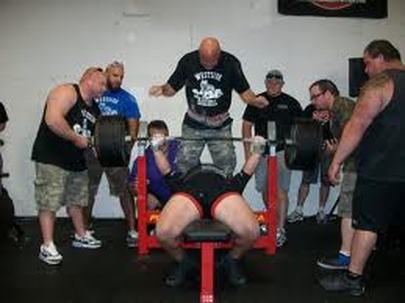
Sunday - Dynamic Effort Bench
Dynamic Bench Press
Triceps
Shoulders
Lats/Upper Back
Monday - Max Effort Squat/DL
Max Effort Exercise
Hamstrings
Low Back
Abs
Dynamic Bench Press
Triceps
Shoulders
Lats/Upper Back
Monday - Max Effort Squat/DL
Max Effort Exercise
Hamstrings
Low Back
Abs
Wednesday - Max Effort Bench Press
Max Effort Exercise
Triceps
Shoulders
Lats/Upper Back
Friday - Dynamic Squat/DL
Dynamic Squat
Hamstrings
Low Back
Abs
Review of the Standard Template
2 days devoted to the bench press
2 days devoted to the squat/deadlift
2 days devoted to dynamic training
2 days devoted to max effort training
4 days devoted to repetition training
Now let's review some of the training parameters within this template. For the sake of simplicity, I'm going to leave out chains and bands. Everything is going to be done with straight weight so there will be no confusion about percentages. Plus, I am going to leave out stance, grip changes, rest periods, etc. In reality, most of this stuff is inconsequential once you grasp the big picture.
Bench Press Parameters for the Standard Template (dynamic, max effort and repetition)
Dynamic bench press - 8 sets of 3 repetitions; all sets done are done with 55% of raw 1RM. Rest periods are approximately 60 seconds, but have never really seen the purpose of this, personally. The whole goal of speed day is to move the bar quickly on the concentric. If you need to take an extra minute to accomplish the goal of the day, then by all means, do so. Also, don't get too hung up on changing your grips. The only reason why I changed my grip on this day was to keep track of the number of sets I was doing. Again, remember why you are doing what you are doing.
Max effort bench press - this includes a variety of exercises, but the most common are the floor press, 2 board press, 3 board press, incline press and close grip bench press. On max effort bench press day, you pick one of these exercises and work to a 1RM. Most will switch to a different exercise every 1-2 weeks and simply try to break their record. On this day, based on your 1RM for THAT day, you will try to do 3 lifts at or above 90%. You can take as much rest as you want, but I would probably say around 3-5 minutes between your heaviest sets.
Triceps - one day is devoted to high intensity/low volume triceps work, the other is devoted to low intensity/high volume triceps. For example, high intensity triceps training would consist of 4 or 5 board presses or rack lockouts. The low intensity training will be geared to triceps extensions and pushdowns. On what day to put each of these is entirely up to you. In my experience, I've always had good results putting the high intensity day on dynamic bench day.
Shoulders - this is similar to the triceps in that there is a high intensity and low intensity day. The high intensity day is technically not high intensity, but high stress. In this category, I would put dumbbell bench press, dumbbell incline presses, military presses (with dumbbells or a straight bar) and dumbbell floor presses. In the low stress category, front raises, side raises and rear raises are good choices. Again, you can choose which day to put them on, but I liked putting the high stress shoulder training on dynamic bench day.
Lats/Upper back - Both days are devoted to lats and upper back and both are done with low intensity, high volume. The way that I worked this is that on Sunday, I would do lat work (usually a row or a pull-up) and no upper back work. On Wednesday, I would do another lat workout (but with a different exercise) and my low stress shoulder work would consist of a rear raise, face pull or a seated dumbbell power clean. So essentially, on the low stress shoulder day, I would kill two birds with one stone: an upper back exercise with a low stress shoulder movement. I did this because I never did front raises or side raises and felt that I got enough stimulation from my other work. It's not gospel, but it's something to think about.
Squat and Deadlift Parameters for the Standard Template
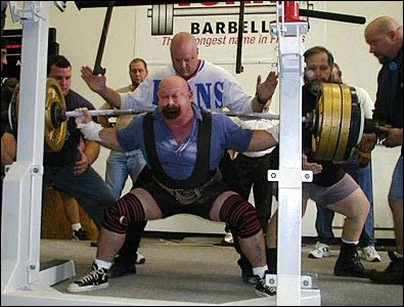
Dynamic Squat - All sets done on a parallel box. A three week wave is used using the following sets and reps.
Week 1 - 10x2 @ 50%
Week 2 - 10x2 @ 55%
Week 3 - 10x2 @ 60%
Upon completion of the 3rd week, you simply start the wave over again. All %'s are based on your best squat. Let's disregard equipment at this point and say it's based on your best 1RM of your box squat wearing whatever you usually wear on this day. Again, refer to my commentary on dynamic bench training regarding rest periods. This is not conditioning, this is speed work. Save your conditioning for another time.
Max Effort Squat and Deadlift - Similar to the max effort bench press, one exercise is used per week and worked up to a 1RM. Because most people have eliminated good mornings as a max effort exercise, I will choose the following for your exercises. I understand that many do not have these bars that I list, but this is the list, nonetheless:
Squat and Deadlift Parameters for the Standard Template
Dynamic Squat - All sets done on a parallel box. A three week wave is used using the following sets and reps.
Week 1 - 10x2 @ 50%
Week 2 - 10x2 @ 55%
Week 3 - 10x2 @ 60%
Upon completion of the 3rd week, you simply start the wave over again. All %'s are based on your best squat. Let's disregard equipment at this point and say it's based on your best 1RM of your box squat wearing whatever you usually wear on this day. Again, refer to my commentary on dynamic bench training regarding rest periods. This is not conditioning, this is speed work. Save your conditioning for another time.
Max Effort Squat and Deadlift - Similar to the max effort bench press, one exercise is used per week and worked up to a 1RM. Because most people have eliminated good mornings as a max effort exercise, I will choose the following for your exercises. I understand that many do not have these bars that I list, but this is the list, nonetheless:

Safety squat bar squat
Cambered bar squat
Manta Ray squat
(All squats are done on a low (1-2" below parallel), parallel or high (1-2" above parallel) box. As you can tell, there is a great many variations with these three exercises.
Rack deadlifts (or pin pulls)
Deadlifts while standing on elevated platform
Reverse band deadlifts
Again, you want to hit around 3 lifts at or above 90% of your 1RM for that day. Most people switch exercises every week or every 2 weeks. Try to break your PR from your previous effort. To make things easier, simply switch between a squat movement and a deadlift movement. Rest 3-5 minutes between your heaviest sets.
Hamstrings - now here is where things get tricky. Unlike the shoulders/triceps routine of high intensity/low intensity, many people are weak at such exercises as the glute ham raise that they simply need to do the exercise and not worry so much about sets/reps. If you don't fall into this category, you can do bodyweight glute ham raises on one day, and on the other day, you can add a band or a plate for resistance.
Cambered bar squat
Manta Ray squat
(All squats are done on a low (1-2" below parallel), parallel or high (1-2" above parallel) box. As you can tell, there is a great many variations with these three exercises.
Rack deadlifts (or pin pulls)
Deadlifts while standing on elevated platform
Reverse band deadlifts
Again, you want to hit around 3 lifts at or above 90% of your 1RM for that day. Most people switch exercises every week or every 2 weeks. Try to break your PR from your previous effort. To make things easier, simply switch between a squat movement and a deadlift movement. Rest 3-5 minutes between your heaviest sets.
Hamstrings - now here is where things get tricky. Unlike the shoulders/triceps routine of high intensity/low intensity, many people are weak at such exercises as the glute ham raise that they simply need to do the exercise and not worry so much about sets/reps. If you don't fall into this category, you can do bodyweight glute ham raises on one day, and on the other day, you can add a band or a plate for resistance.
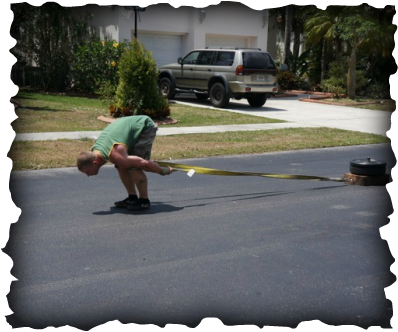
Low Back - Again, we cannot really isolate the lower back without hitting the glutes and hamstrings. But you can pick from exercises such as back raises, 45 degree back raises, Reverse Hyperextensions, pull-throughs and good mornings. Depending on how you do some of these exercises (i.e. with a great amount of intensity) you can use ONE of these for your hamstring and low back exercise. For example, good mornings can be done for both. If you were to pick reverse hyperextensions or pull-throughs, then you can get away with doing an extra hamstring exercise. Some people can train their lower back twice a week, others cannot. A good way to do this is to pick one "easy" exercise (R.H., pull-throughs, un-weighted back raises or band good mornings) on one day and pick a heavier exercise on the second lower body training day.
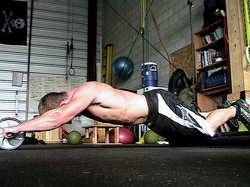
Abdominals - These are usually trained heavy twice a week in the standard template. Some good exercises to choose from weighted sit ups, Roman Chair sit-ups, stability ball, hanging leg raises, side bends. This is not very complicated but you just need to do them; that's usually the hardest part.
Abdominals - These are usually trained heavy twice a week in the standard template. Some good exercises to choose from weighted sit ups, Roman Chair sit-ups, stability ball, hanging leg raises, side bends. This is not very complicated but you just need to do them; that's usually the hardest part.






 RSS Feed