Picture
When developing strength & athleticism, there are certain muscle groups that deserve more attention than others. Sure, we want to be strong top to bottom with no weak links, but not all muscles are created equal. The two groupings that usually need the most attention are the abs and the ass, guts and butts. The glutes are the largest single muscles in the body and, as the primary hip extensors, are the driving force behind nearly all athletic movements. Stronger glutes help you run faster, jump higher, hit harder, and on a side note, can improve your sexual performance. The glutes however, cannot function optimally if the pelvis isn't correctly positioned and stabilized, which is predominately controlled by the abs. Weak abs usually allow a prominent anterior pelvic tilt, while adequate ab strength and control will ensure that forces around the hip and lower spine are properly controlled and will allow for the glutes to do their job. Improper strength and control of the trunk muscles can also lead to back and knee pain or injuries. Similarly, weak and poor functioning glutes have been linked to low back pain. 

Thus, getting these muscle groups working properly is of prime importance for health, fitness, sexual and athletic performance enhancement. Improving yourself physically isn't just about making time to get to the gym. It's about making it a part of your lifestyle. There are tons of things you can do at home, during quick breaks at work or in any time crunch that can improve your situation. If you're serious you'll make time, not excuses. Below is quick video of my favorite things to do anywhere, anytime, with no equipment, to strengthen, stabilize and mobilize your gut and glutes, which improves the functionality of your hips, which will make you more awesome. 

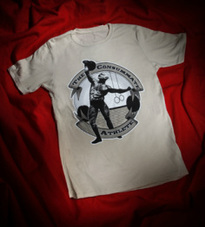
Performing these exercises is a good idea, but don't forget the main point here is to strengthen and improve mobility and stability in the muscles around your hips. There are many ways to achieve this, this video is just the tip of the iceberg. Bodyweight Training is awesome and can be performed almost anywhere with minimal equipment, but my biggest passion still lies in the iron. Feel free to share your favorite hip and ab strengthening and mobility drills below. Many others are sure to benefit from your knowledge. Also, NEW Consummate Athlete T-Shirts are available now. Click on any pic below to get yours today!
 
 
Picture
I can say, without a doubt, that the perfect strength & conditioning program does not exist for everyone, all the time. BUT, it is very possible to find the best solution for your particular goals at a given time with proper application. Many people never evolve from doing what they love or are good at. Sometimes you have to do the things you hate to escalate your ability to the next level. If you always do the same thing, you'll always be in the same place. So, if you're 100% satisfied with your current results, that's great! Keep on keepin on. However, if you are ready to drive your current situation to get better results, are tired of thinking about what to do next, or simply need more information to achieve your goals, you just might need to get a coach to help you get what you want in life. One of the benefits of you not having to worry about any planning, you can put 100% focused effort into implementation and training hard and not worry about if you're doing something right or wrong.

A good coach is going to provide solid cues and feedback to ensure positive results from your efforts. Let's take the deadlift, for example. If you know what you're doing, it seems very natural, you just pick up something heavy and anyone else watching from the outside sees something very simple. However, only you knew all the minute details from years of training that went into that quick effort that made it look easy. But if you have to think while training, you may need constant reinforcement when straining hard during your heaviest work sets. If you don't have a good coach or training partners with you, the next best thing is having proper knowledge of execution and implementation to guide your path to increased strength & conditioning. Since we are already talking deadlifts, lets hammer some nuts and bolts on proper execution to perform a big pull safely.


To figure out the best stance for your deadlift, pretend you’re about to perform a vertical jump. Get your feet and body into position. Now, look down and move your feet in slightly and your toes out slightly. This may change a bit with experience, but it's a good starting point. Address the bar so it is an inch or two in front of your shins, when you bend over to grab the bar your knees and shins will come forward a bit to meet the bar. Try pushing your entire foot through the floor with weight shifting towards the middle to back of your foot. Relax your back as you grab the bar and set your grip. Your hands will be just outside your legs and you'll have to decide whether you use an overhand grip, alternate grip or hook grip. I recommend a double overhand grip until it fails with heavier weight. If you're an oly lifter or have joint or tissue problems in your shoulder or elbow, you should use a hook grip. If an alternate grip does not bother you, that is a strong option as well. Once the grip is set, now set the back by pulling yourself down into the bar and flatten your back. You'll notice how some advanced lifters have a slightly rounded upper back when pulling big, but DO NOT worry about that for now, it's not for you, YET. Just try to squeeze your upper back and flatten out your spine by pulling tension from the bar. As you set your back, take a big breathe in and fill your gut with air. Squeeze the bar as hard as possible, set your back and push your feet through the floor. Never yank the bar from the floor unless your name is Kendrick Farris. Instead think of a rocket being launched into space, it starts slow and generates more power and speed as it rises. As you prepare your lift, repeat your mantra, "Feet flat, butt down, chest up." Some do better by looking up, some look down a bit. But to keep you safe as a beginner, you want your neck to be in alignment with your spine, so focusing on a spot on the floor about 20 feet in front of you will keep you in a safe position. As you practice and grow over the years, you may find that looking up as you pull the lift might help your performance. Again, think about pushing the earth away from you with your legs and try to keep your back flat, this is why its imperative to have strong legs for a big pull (and a big pull will give you stronger legs). As the bar begins to rise, keep pulling back onto your heels and get your bodyweight going back to help counter the force of the bar in front of your legs. Keep the bar close and think about shaving your legs with the bar, not ripping meat of your bones. Once the bar gets to your quads, squeeze your glutes and push your hips towards the bar, but do not bend back. As you stand tall, pull your shoulders back slightly to ensure an erect posture. Pause at the top and either drop the weight or return the bar to the floor by reversing the movement, push your hips back and slide the weight down your thighs. I recommend you treat the deadlift as a series of single repetitions, resetting after each pull. There is validity in touch and go reps as well, where the bar basically taps the floor before you stand again, you have to find out what style is best for your goals and situation. Never bounce the weight, if you're bouncing or crashing the weight off the floor, you would be better off doing kettlebell swing variations, my favorite being heavy double swings either inside or outside the legs.

That single paragraph above is enough to get you rockin and rollin, but as you progress, there is so much more you need to know. And as the saying goes, "You don't know what you don't know." Get it?

Picture
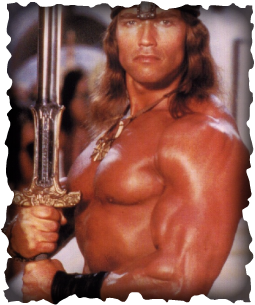
When I started on my road to increased strength and athleticism, I read a lot of the bodybuilding magazines and followed the studs of the day. It was 1990 and Arnold Schwarzenegger was everywhere, on TV and on all the newsstands.  I wanted to be big and strong, I mean, who didn't?  I didn't know anything about athletic training for a long time, I just followed the bodybuilder's lead. It didn't align perfectly with my goals but I didn't know it at the time, I just worked hard and got bigger and stronger by following the plans that were laid out for me. I learned that working hard and being consistent for a long time is the best plan anyone can follow. Screw optimal sets and reps and rest times, if you can't stick to it long enough to get results, it doesn't matter how perfect the plan was to begin with. 

The important lesson that I learned from Arnold was that even at a young age his ability to outwork everyone else around him quickly separated him from everyone else. I wanted that for myself. I was always the youngest and smallest kid in every sport I played. The other kids were bigger, stronger and faster than me all through my youth. I was the late bloomer. It forced me to work harder just to keep up. When everyone else around me was tired and working at level 6, I was pushing hard at level 10. Eventually, I was able to play with the big dogs and I maintained my work ethic because its all I knew.


The kids who skated by on talent never trained after practice, they never did anything extra. And that caught up with them. Hard work beats talent when talent doesn't work hard. I eventually took my teammates positions in the starting line up, and year after year I watched some my peers quit the team, or fail out, while the rest of us thrived and excelled. I made All-State in high school, All-American in college, league MVP, and conference best offensive player all because I had a dream and a vision to get better then what I was. I never wanted to be the same Matt that I was yesterday. Every single time I stepped out on that field, I wanted to be new and improved. That does not happen by doing the same thing over and over again. If you want to grow and get better, you must improve your practice.

Ask yourself, "Am I performing the way I want right now? Am I the very best I can be? Do I have the desire to get better?"

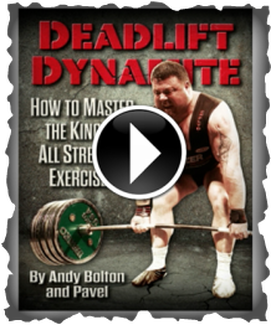
If you want to see your strength and conditioning improve over the next months and years to come. You need to take aggressive action and get a plan and stick to it long enough to see results. Two of the best resources out there right now for improving your strength & conditioning are from some of the best in the business. Deadlift Dynamite from Pavel and Andy Bolton, the world record deadlift holder, is on sale for the next few days and has such an overwhelming amount of information to guarantee results that you'll notice immediately and for years to come. They are offering several FREE tips to improve your performance just for checking out the link, so check that out and see what you get. These is some of the best strength information available.

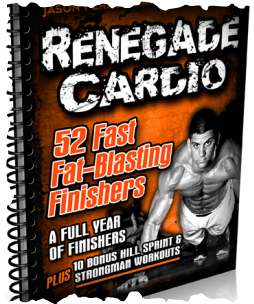
Now for conditioning and getting that ripped body, Jason Ferruggia is having a big sale on his Renegade Cardio book, it has 52 workout finishers for you to plug into your strength program so its the perfect marriage for Deadlift Dynamite. And the best part is, it's ONLY $10! Traditional cardio is dead and who wants to conjure up a new workout or finisher every day. This is done for you and you'll gain tons of new training ideas for only a few bucks. You can't miss. I wouldn't recommend it if I didn't love it. Even if you're already doing workout finishers, you'll love the new ideas from these resources.

I want you to start seeing yourself five and even ten years down the road, is the path you're on going to get you where you wanna be? Start separating everything in your life into two categories: things that were going to help you reach your goals of increased strength & conditioning, and things that had nothing to do with getting you the results you want. Start making choices in life based on those categories. Would partying, drinking and skipping workouts to hang out on the corner all night with your friends make you stronger? Would staying up all night talking to a girlfriend on the phone make your bench go up? It shouldn’t be hard to answer these questions. If you're serious, start doing only the things that will one day lead to success.

Have a goal, have a vision, here is your plan... Deadlift Dynamite & Renegade Cardio. The perfect marriage of Strength & Conditioning. These amazing products are on a huge sale for only a few days.

If you need a solid diet plan as well, I recommend Carb Back-Loading to fuel your rage and get you that lean, strong body you're after.

Picture
Deadlift Dynamite is a great educational tool that teaches lifters of all ages about proper technique and programming strategies.  Some valuable topics they cover that stand out are:

1. Determine whether you're better built for the conventional or sumo deadlift technique.
2. Deload prior to meets/testing days.
3. Integrate kettlebell exercises with more traditional powerlifting training.
4. Manage your breathing during heavy deadlifting (I wish someone had taught me this eight years ago).
5. Build a solid hip hinge so that you can deadlift safely.
6. Make sure you appreciate the difference between how Olympic lifters deadlift (first pull) and how powerlifters do so.
7. Pull yourself down to the bar (this is a HUGE game-changer for lifters when they finally "get it," especially on deadlift bars with a lot of whip)
8. Utilize compensatory acceleration training: performing the concentric (lifting) portion of the movement as fast as possible, regardless of the weight.

Bolton and Pavel also go into great detail with respect to training the squat and deadlift. This is something I wish I had a long time ago, and I highly recommend it to anyone who wants to get better. It's on sale through this Sunday, November 18 at midnight and it comes with a whole bunch of special bonuses. Go check it out.


Picture
A quick glance at what you get with Renegade Cardio...
  • “One in the Chamber”- A collection of finishers based on only one exercise or training implement.
  • Bodyweight Circuits- A collection of finishers based on nothing but bodyweight exercises that can be done anywhere, anytime. On the road, in a hotel room, on the beach, you name it.
  • Kettlebell Killers- Various kettlebell circuits to jack up your conditioning and incinerate bodyfat.
  • Bike Circuits- If you have to use a bike for conditioning this is the way to use it. Discover how to mix bike intervals with various other exercises for maximal results.
  • Battling Ropes & Jump Ropes- Low impact circuits that produce awesome results.
  • Barbell Complexes- The most effective barbell complexes that only require an empty bar and some space.
  • Pyramids- One of my favorite conditioning methods and definitely not for the weak of heart.
  • Deck of Cards- One of the most popular yet feared workouts at Renegade Gym.
  • “On the Mix Now”- A collection of various circuits incorporating bodyweight, kettlebells, ropes, sleds, sledgehammers, sandbags, medicine balls and more.
  • Plus 10 bonus hill sprint and strongman workouts


Picture
CBL is the brainchild of John Kiefer, a nutrition consultant to athletes including bodybuilders, powerlifters, and figure competitors. As the name suggests, it entails saving the bulk of your carbohydrate intake for the end of the day. The big selling point for CBL is all the so-called junk food you can get away with on it. We’re talking pizza, ice cream, and french fries, and not only will they not make you fat or unhealthy, they’ll make you big, strong, and lean.

This type of diet is becoming more and more popular since the participants actually get to eat all sorts of junk food without actually getting fat, providing that the carb back-loading 1.0 technique is followed correctly, otherways it will just become another junk food binge that will in fact make you fat.

There is science behind this technique and that is why it works. If you live a lazy lifestyle, the sugar spikes will normally translate to fat gain because your muscles and other cells are not depleted, so your body stores the excess carbs as fat. While if you train hard and eat low carb for 10 days while depleting your body, all these carbs that you consume will go directly in to your muscles and other cells that you have worked really hard over that period of time.

This technique is very simple, once you have completed the 10 days of low carb eating, 30 grams max, on the tenth day, that night you can load up with as many carbs as you can handle. From there on, it is low carb eating during the day, training during the day to deplete your body of all carbs, and load up on carbs again at night, it is really that simple, but to learn the proper technique that is optimum and tested on professional athletes, power lifters, fitness models you really need to get your hands on the CBL system if you want to get started with Carb Back-Loading technique to look better and be happy with your body.


Picture
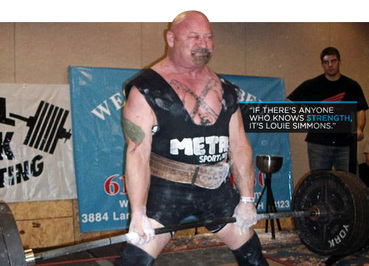
By: Louie Simmons
When lifters repeatedly use the same simple method of training to raise their strength level, they will eventually stall. Like the scholar who must utilize many sources of information to achieve a higher level of knowledge, the lifter must incorporate new and more difficult exercises to raise their standards. Many have the theory that to squat, bench, or deadlift more, you simply have to do the three lifts. If it were that simple no one would need special exercises, machines, or systems of training. But we know this is not true.

Because lifters have different body types, they may excel at one lift but struggle with another. The great Lamar Gant was the only lifter I have known who held the world record deadlift and bench at the same time. There are men who hold three world records in the deadlift, yet can’t make the top 10 bench list. Their muscles in the upper body are, I’m sure, as strong as anyone’s, but they are limited by body structure, e.g., short torso, long arms. Many of us are affected by this. But is there an answer?

In the early 1970s, the Dynamo Club in the former Soviet Union had 70 highly skilled Olympic lifters. They were introduced to a system of 20-45 special exercises that were grouped into 2-4 exercises per work-out and were rotated as often as necessary to make continuous progress They soon found out that as the squat, good morning, back raise, glute/ham raise, or special pulls got stronger, so did their Olympic lifts. When asked about the system, only one lifter was satisfied with the number of special lifts; the rest wanted more to choose from. And so the conjugate system was originated.
When you have a body type that lacks say, the muscles that squat and yet you squat on a regular basis, then a coupling of special exercises for the glutes, hamstrings, hips, and lower back are needed to fortify those areas. These special exercises will en-able you to raise your squat once more.
Think about it if you read only one book, no matter how many times you read it, you will only learn so much. If you only squat, you will get only so strong because no new stimulus is introduced. This may not happen in the early stages of training, but as you become more advanced, you will need a more strenuous method of training. This training will indeed help your motor potential and help you to perfect your technical skill.


Picture
Before I present some examples of conjugate training, think about this. How much could you bench press the first time you tried? 200? 300 perhaps? Now how did you achieve that level of strength without ever having benched be-fore? You did it through simplified training such as pushups and pull-ups. Those of you who could bench 300 the first time will never double that amount without doing specialized work to raise your strength, right?

Here are some examples of the conjugate method. Glen Chabot bench presses only twice a month. Both times he uses a close-grip style He can do 405 for reps in the low teens. His best single close grip is 635 without a shirt. In between each workout, he rotates heavy dumbbell work on a flat or incline bench or very heavy bodybuilding exercises for lats, delts, pecs, and triceps.
This linking of special exercises has given Glen a 705 bench press at 275. Glen does not arch when he benches and has fairly long arms. He realized that he needed a special program to fortify his pressing muscles. This is a simple but very effective training program.

A more complex system is Kenny Patterson’s. He will do floor press, chain press, board press, incline press, and over-head press, just to name a few, rotating to a different- exercise each max effort day. On the dynamic day, Kenny uses three different grips on the bench press and uses 60% of his no-shirt max for 8 sets of 3 reps. He adds a lot of triceps extensions with dumbbells or the barbell, rows (one-arm, two-arm, chest-supported), pull downs, delt raises, and forearm work. This is a more complex system than Glen’s, but it suits Kenny’s needs. Kenny is a legitimate 700 bencher, having done it several times across the country.

Picture
Mike Ruggiera and myself just made 900 squats. It was a 50 pound increase for him and a 40-pound increase for me, yet we did not do a single regular squat in between meets. We do box squats on speed days with a large amount of bands and weight. We also use the reverse hyper machine and do glute/ham raises, pull-throughs, and abs. I pull a weighted sled before my squat workouts.

On max effort day, we do good mornings (five varieties), belt squats, speed deadlifts (60% for 6-8 singles), and Safety Power Squat Bar squats to different box heights. Mike also pulled his first 800 deadlift, without having done any conventional squats and no big deadlifts. After squatting he does deadlifts for singles with 60% for speed, and three days later he maxes out on special work: this is the conjugate method.

To push up a squat, heavy good mornings or squatting with different bars is done on max effort day. The different bars make squatting very awkward and extremely hard to do, much harder than a regular squat. (The same is true of box squats; they are harder than competition squats.) On max effort day we may do a type of squat on week 1, a good morning on week 2. and a front squat on week 3, each exercise contributing to the next week’s exercise, which in turn will build a bigger squat by strengthening the weaker muscle group and perfecting form.

The training is linked together, enabling you to raise your total. For instance, to build the glute and hamstring area, push up your reverse hyper extensions as hard as possible until your progress slows. Move on to pull-throughs for a week or two, until progress in these slows as well. Then go to glute/ham raises, and again push as fast and hard as possible. Then pull a sled walking forward to build the glutes/hamstrings. It is possible to continuously gain strength in any body part by switching special exercises. As the effectiveness of the exercise decreases, switch to another one. By training in this manner, it is possible to raise all types of strength throughout the year.


Picture
On max effort day the entire volume consists of unidirectional loading. One training workout contributes to the next. Keep in mind that if you train a lift at 90% or more for more than 3 weeks, your central nervous system is negatively and your progress will go backward. But by switching exercises each week (for the high-level lifter), you can use 100% and more each week. The sequence of exercises you use does not matter, as long as the load is maximal. The time it takes to do a maximal effort, for example in a low box squat with a Manta Ray, takes at least as long as max deadlift or squat. This is called “time under tension”.

The conjugate method also improves SPP (special physical preparedness e.g., speed deadlifts, plyometrics) and GPP (general physical preparedness; e.g., sled dragging). This is the most effective method to gain strength continuously throughout the year, with no ridiculous off-season. No one can afford to take time off. By maintaining the speed work for the three lifts and increasing general wonk (e.g., upper and lower body sled work, lats, abs, and triceps) you won’t go back-ward. There are many methods of training, but by incorporating the conjugate method, you can’t miss.

Picture

The following is a great summary of The Conjugate Method by EKnight from the innerwebz muscle forums:

For those who are curious, interested, or otherwise just looking for what is considered by most elite powerlifters as the best training regime, this is the Westside Barbell Club powerlifting routine. I used these training methods on the way to personal bests of 420 pound bench at a bodyweight of 140 pounds and 370 pound bench at 132. This is NOT a hypertrophy routine, should not be used by anyone who is still growing, anyone without spotters (yes, there are very heavy weight, low rep days), or anyone not medically cleared to lift heavy weight or exercise regularly. I have NO affiliation to the WSB club (they're in Ohio, I'm in the Southeast), and I give full credit to Louis Simmons for development of the routine and to Jim Wendler whose info I used to post this. Enjoy!


Picture
Sunday - Dynamic Effort Bench

Dynamic Bench Press
Triceps
Shoulders
Lats/Upper Back


Monday - Max Effort Squat/DL

Max Effort Exercise
Hamstrings
Low Back
Abs

Picture


Wednesday - Max Effort Bench Press

Max Effort Exercise
Triceps
Shoulders
Lats/Upper Back


Friday - Dynamic Squat/DL

Dynamic Squat
Hamstrings
Low Back
Abs


Review of the Standard Template

2 days devoted to the bench press
2 days devoted to the squat/deadlift
2 days devoted to dynamic training
2 days devoted to max effort training
4 days devoted to repetition training


Now let's review some of the training parameters within this template. For the sake of simplicity, I'm going to leave out chains and bands. Everything is going to be done with straight weight so there will be no confusion about percentages. Plus, I am going to leave out stance, grip changes, rest periods, etc. In reality, most of this stuff is inconsequential once you grasp the big picture.

Bench Press Parameters for the Standard Template (dynamic, max effort and repetition)

Dynamic bench press - 8 sets of 3 repetitions; all sets done are done with 55% of raw 1RM. Rest periods are approximately 60 seconds, but have never really seen the purpose of this, personally. The whole goal of speed day is to move the bar quickly on the concentric. If you need to take an extra minute to accomplish the goal of the day, then by all means, do so. Also, don't get too hung up on changing your grips. The only reason why I changed my grip on this day was to keep track of the number of sets I was doing. Again, remember why you are doing what you are doing.

Max effort bench press - this includes a variety of exercises, but the most common are the floor press, 2 board press, 3 board press, incline press and close grip bench press. On max effort bench press day, you pick one of these exercises and work to a 1RM. Most will switch to a different exercise every 1-2 weeks and simply try to break their record. On this day, based on your 1RM for THAT day, you will try to do 3 lifts at or above 90%. You can take as much rest as you want, but I would probably say around 3-5 minutes between your heaviest sets.

Triceps - one day is devoted to high intensity/low volume triceps work, the other is devoted to low intensity/high volume triceps. For example, high intensity triceps training would consist of 4 or 5 board presses or rack lockouts. The low intensity training will be geared to triceps extensions and pushdowns. On what day to put each of these is entirely up to you. In my experience, I've always had good results putting the high intensity day on dynamic bench day.

Shoulders - this is similar to the triceps in that there is a high intensity and low intensity day. The high intensity day is technically not high intensity, but high stress. In this category, I would put dumbbell bench press, dumbbell incline presses, military presses (with dumbbells or a straight bar) and dumbbell floor presses. In the low stress category, front raises, side raises and rear raises are good choices. Again, you can choose which day to put them on, but I liked putting the high stress shoulder training on dynamic bench day.

Picture
Lats/Upper back - Both days are devoted to lats and upper back and both are done with low intensity, high volume. The way that I worked this is that on Sunday, I would do lat work (usually a row or a pull-up) and no upper back work. On Wednesday, I would do another lat workout (but with a different exercise) and my low stress shoulder work would consist of a rear raise, face pull or a seated dumbbell power clean. So essentially, on the low stress shoulder day, I would kill two birds with one stone: an upper back exercise with a low stress shoulder movement. I did this because I never did front raises or side raises and felt that I got enough stimulation from my other work. It's not gospel, but it's something to think about.

Squat and Deadlift Parameters for the Standard Template

Dynamic Squat - All sets done on a parallel box. A three week wave is used using the following sets and reps.

Week 1 - 10x2 @ 50%
Week 2 - 10x2 @ 55%
Week 3 - 10x2 @ 60%

Upon completion of the 3rd week, you simply start the wave over again. All %'s are based on your best squat. Let's disregard equipment at this point and say it's based on your best 1RM of your box squat wearing whatever you usually wear on this day. Again, refer to my commentary on dynamic bench training regarding rest periods. This is not conditioning, this is speed work. Save your conditioning for another time.

Max Effort Squat and Deadlift - Similar to the max effort bench press, one exercise is used per week and worked up to a 1RM. Because most people have eliminated good mornings as a max effort exercise, I will choose the following for your exercises. I understand that many do not have these bars that I list, but this is the list, nonetheless:


Picture
Safety squat bar squat
Cambered bar squat
Manta Ray squat

(All squats are done on a low (1-2" below parallel), parallel or high (1-2" above parallel) box. As you can tell, there is a great many variations with these three exercises.

Rack deadlifts (or pin pulls)
Deadlifts while standing on elevated platform
Reverse band deadlifts

Again, you want to hit around 3 lifts at or above 90% of your 1RM for that day. Most people switch exercises every week or every 2 weeks. Try to break your PR from your previous effort. To make things easier, simply switch between a squat movement and a deadlift movement. Rest 3-5 minutes between your heaviest sets.

Hamstrings - now here is where things get tricky. Unlike the shoulders/triceps routine of high intensity/low intensity, many people are weak at such exercises as the glute ham raise that they simply need to do the exercise and not worry so much about sets/reps. If you don't fall into this category, you can do bodyweight glute ham raises on one day, and on the other day, you can add a band or a plate for resistance.


Picture
Low Back - Again, we cannot really isolate the lower back without hitting the glutes and hamstrings. But you can pick from exercises such as back raises, 45 degree back raises, Reverse Hyperextensions, pull-throughs and good mornings. Depending on how you do some of these exercises (i.e. with a great amount of intensity) you can use ONE of these for your hamstring and low back exercise. For example, good mornings can be done for both. If you were to pick reverse hyperextensions or pull-throughs, then you can get away with doing an extra hamstring exercise. Some people can train their lower back twice a week, others cannot. A good way to do this is to pick one "easy" exercise (R.H., pull-throughs, un-weighted back raises or band good mornings) on one day and pick a heavier exercise on the second lower body training day.

Abdominals - These are usually trained heavy twice a week in the standard template. Some good exercises to choose from weighted sit ups, Roman Chair sit-ups, stability ball, hanging leg raises, side bends. This is not very complicated but you just need to do them; that's usually the hardest part.


Picture


Picture

This is a guest post from Joe Meglio, the Jersey Bandit, The Beast Coast Breaststroker, The Not So New Kid On The Block, the Bieber Fever Believer, The Deadlift Denominator, The Slayer Player, The Zach Even-Esh Liquefier, The Mid-Atlantic Fiber Frosted Fruitcake Flinging Flabergaster, The Bitchin Banana Hammock Hootenanny Host, the dude who has a bigger pull than you! When someone with ten badass nicknames talks, you listen. You're on, Joe...

One of the biggest problems I see in high school and college athletes is their off season training program. Too often I see high-level athletes performing the WRONG exercises. Instead of focusing on the basic exercises that have been proven to work, they focus on these gimmicky exercises that don’t improve athletic performance.

Simply put, you don’t have time to waste in the gym doing exercises that might work. Focus on the basics, as they are proven to deliver the best results. If I ask you why you are doing a specific exercise and you don’t have a legitimate answer, then scrap it.

When it comes to choosing the best strength exercises, you need to consider training economy, getting the most bang for your buck. As an athlete you need to spend time and energy developing your positional skills.

In this post I will focus on the ‘Top 5 Lower Body Strength Exercises’ for athletes. While jumps, medicine ball throws and sprints are critical to developing rate of force development and explosiveness, it is really useless unless you have a solid foundation of strength.

Here are the Top 5 Lower Body Exercises For Athletes:

Picture
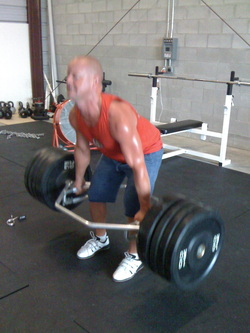
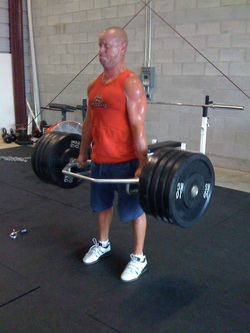
Trap bar deadlifts are an awesome exercise for you to strengthen your entire posterior chain. While conventional or sumo style deadlifts are great, trap bar deadlifts are easier to learn and very effective when done properly. Trap bar deadlifts are also less taxing on the body than traditional deadlifts.

When you do trap bar deadlifts, make sure you are sitting back and are keeping the tension on your hamstrings. Do not turn it into a squat.


Picture
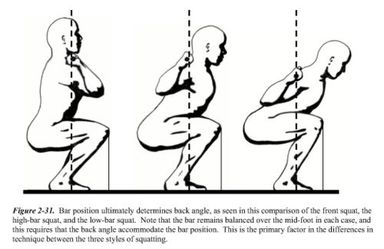
I am sure you have heard 1,000 times that squats are the king of all lower body exercises and should be a staple in your training program. There is no denying that but a better question is what type of squats should you do? While some coaches prefer back squats, I find front squats to be superior for a few reasons. Front squats are much easier on the lower back because there are less compressive forces on the spine when compared the back squat. In addition to this the trunk is engaged much more in front squats compared to back squats.

Not to mention, you will have easier time learning front squats compared to back squats because it is much easier to maintain a neutral spine and upright torso in the front squat. Front squats can be done with kettlebells, sandbags or a barbell.


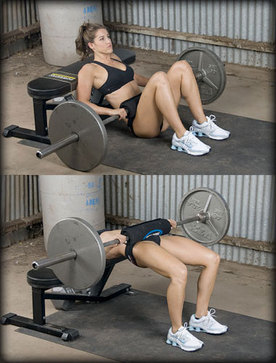
Popularized by Bret Contreras, hip thrusts are the best way to train the glutes. Simply put, if you want to run faster, jump higher or do any explosive athletic movement, you need to have strong glutes.

Check out the video of Bret Contreras breaking down proper technique on the hip thrust. Also check out his report on Dispelling the Glute Myth. 
dispelling_the_glute_myth.doc
File Size: 113 kb
File Type: doc
Download File


Hooray for the Glute Guy, Bret Contraras!!!

Picture
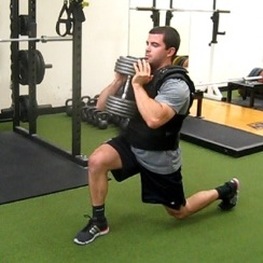
Unilateral leg training is critical to your performance because all athletic movements require you to produce force off of one leg. Think about anytime you go to make a cut on the football field, go up for a layup or dunk on the basketball court, or range to your right to field a ground ball on the baseball diamond.

Front loaded reverse lunges place a greater emphasis on the core compared to other unilateral leg exercises where you are holding the weigh at your side or on your back. Another major benefit of this exercise is it will improve your hip stability and help you overcome muscular imbalances caused from your sport.


Picture

Matty couldn't let everyone else have all the fun, he had to throw in at least one video of himself. Here is one of his very first videos, doing some front loaded unilateral work (pistols), along with some super sweet kipping pullups. For the record, I, Joe Meglio, think Matty is the dopest fucker out there, yo! (ok ok, Matt wrote this, I'm sure you're fooled)

Picture
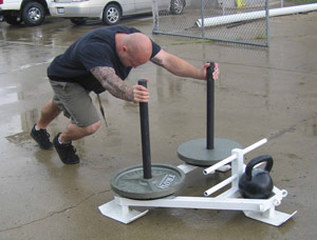
The prowler and sled are awesome tools because of their effectiveness and their versatility. They can be used for many different goals and can be good for beginner athletes all the way to the professional rank.


The prowler is a great way to improve work capacity and general physical preparation. You can also load the prowler up with super heavy weight and push it for shorter distances to improve lower body strength with minimal stress on your joints. And finally, the sled and prowler can also be used as a rehabilitation tool when you are recovering from an injury and you need to do low impact exercises.


While there are a ton of other great lower body exercises, these are my go to ones because they work! In the next part of this installment I will share my top 5 upper body exercises for athletes.

If you want a program specifically designed to increase your athleticism and transform you into a freak athlete, check out my Lift Like A Man Training Course.

This is the exact system I use to get my athletes bigger, faster and stronger.

P.P.S Want more awesome muscle and strength building tips from Joe? Click here to get your FREE report http://musclebuildingcheatsheets.com/

And a "Connect with Joe on Facebook" http://www.facebook.com/meglioperformance

Follow Joe On Twitter  https://twitter.com/JoeMeglio
 
 
I believe that when trying to maximize your athleticism, finding a good balance of high power, big weight, and high reps is important. This first video shows one of my favorite drills for mobilizing my back, hips and legs, and getting me ready for more intense exercise. The straddle forward roll is  a fantastic drill to create body awareness, activate and stimulate many muscles, and get you dizzy as hell. Spread your legs while keeping them straight, roll over while using your arm strength to protect your head and neck, and pull yourself back up with momentum and core strength. 
After my warm up drills, I like to begin most of my sessions with a variation of a high power exercise. This will be dependent on your goals and personal situation, but one of my favorite drills is simple jumping and occasionally flipping. If you are serious about learning gymnastics, see a coach and stop trying to learn everything via YouTube. I'm a 34 year old dude training in a park, I enjoy flipping and practicing basic parkour drills to enhance my athleticism.  If you want perfection, seek out the best coach possible for personal instruction and learn whats best for you and your ability. These drills are just a few of the many movements I do for dynamic preparation. Sometimes done right at the begining of a heavy session, sometimes on a totally separate day. You can try and find the perfect program all you want, but nothing is more important than manning up and getting it done whenever possible, regardless of your situation. Insane work ethic trumps perfect planning every time. Like Dan John says, "If it's important, do it everyday." 

Picture

Because I enjoy gymnastic training so much, and have fun teaching the basics to my athletes, I am heading out to Arizona in a few weeks to train with Coach Sommer and his crew for a 3 day seminar at his amazing facility. He is one of the most highly respected gymnastic coaches in the country. I am so excited about this 3 day workshop because of the amazing information I learned at the 1 day workshop a few months ago in Miami. Of course, as I acquire new skills and hone my coaching ability, I will have tons of new information to pass on to those who seek high quality training information from me. 

Like I said, I am not a tricking or parkour pro, I just like getting out and having lots of fun and experimenting with my body. This is a great way to express my athleticism, but not necessarily my favorite way to develop it.  These guys below, and many others like them, express amazing athletic ability with their tricking. But it is all almost purely dynamic effort. The best thing for them, in my opinion, to supplement their tricking, would be heavy slow movements, and not any more dynamic work. Squats, deadlifts and pressing is ideal for them to strengthen and stabilize their muscles and joints. Jerks, snatches, and other high power explosive movements in the gym are redundant because they are already doing plenty of that shit already with their tricking. It's similar to a basketball players in season training. There should not be a need for the basketball player to do any box jumps, or high power exercise in season due to the high volume they are already getting with jumping and sprinting in the games. The only thing they really need is basic strength and stability exercises to keep them strong and protected from injury. Off season jumping and power training is a different story, just like if these guys in the video took a few months off from tricking, they could add lots of power drills in the gym as well. 
Speaking of the ability of the hips and torso to generate power, check out how efficient Sergey is, and imagine the power that he has learned to harness over the years of training full body exercises. He utilizes massive spinal flexion and extension to generate a tremendous amount of force over a very long period of time. 
And of course, getting a few heavier reps in always feels great. This was my last set of five triples. To avoid being limited by my grip, I used straps and went double overhand grip to protect my elbow, which has been giving me minor issues lately with the increased gymnastic rings training I have been doing. I have been tweaking my pulling style and playing with sumo for a bit to see how it goes. It feels much easier to pull the weight and I'll keep experimenting until I get what I am looking for. Is this going to be the year I rip 600 off the floor? 

I have tons more great training information on the blog, look around. Here is an awesome video of Dave Tate discussing the deadlift at one of his Learn to Train seminars I attended a while back. Below is a great video from Mark Bell from SuperTraining coaching the Sumo Pull. Check it...

I am very excited about what the future holds for TSS. The week after I return from Arizona from my gymnastics seminar, I go back to the Dirty Jersey to be one of the presenters at Zach Even-Esh's Underground Strength Conference, which is sold out by the way. Check out the link, insane info will be shared and there are some incredible coaches presenting on business, success, training, and life. 

After that I am we are on our way back to Europe, this time Copenhagen, for my BBB seminar at CrossFit Copenhagen. There are a few spots left, so if you are in northern Europe, you need to get to this seminar. SIGN UP HERE! I will be fresh out of two amazing weekends myself, so the new information and content that I will have acquired will blend nicely with my current seminar information. 

We also have a few more seminars in the works, the sign up links will be available soon! Thanks for stopping by, leave any comments or questions with what is going on with you. And Finally, if you're interested in joining our training camps here in Fort Lauderdale, contact me and we will set you up with a big time introductory discount. Be good, and Happy Mother's Day to all you Hot Mama's out there!  
 
 
Dave Tate from EliteFTS discusses the deadlift at the "Learn to Train Seminar".  To watch the entire 13 minute video, join The Consummate Athlete today. It's FREE for a week, and then only ten measly bucks a month after that to get all the training information you want from myself and all the other amazing coaches that I have direct access to. Contact me for questions and get started immediately. Click here for you FREE trial!


Picture
Picture
Robby Trap Bar Deadlift
1a. 1 arm KB snatch 3x6-8
1b. Band pull aparts 3x20

2. BB Power Snatch 8-10x1

3a. Deadlift 4x1-1-1
-cluster set
3b. BB Power Curls 4x6-8

4a. Good morning 3x10
4b. Jumping lunges/bulgarian split squats 3x10/10

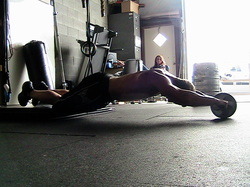
5a. Ab rollouts 3x10-15
5b. Reverse hypers 3x10-15

6. Sprint 10x25 meters


Picture
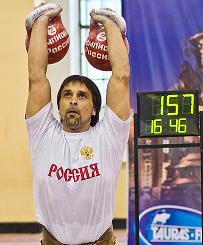
Sergey Rachinskiy

Notice how the kettlebell sits in the palm of the girevik in the above photo. Sergey Rachinskiy is a Russian and World champion in his sport, he is worth learning from. He punched his hand all the way through the handle of the bell so it sits on his lifeline in his palm, meaning there is little or no visible palm showing under the bells handle. Do this and you will have a much stronger overhead position.

1a. 1 arm KB snatch 4x6-8
1b. Band pull aparts 4x20


2. BB 3 position snatch 5x3 
-high hang, below knee, floor

3. Deadlift 6x4


4a. GHR 3x10
4b. Jumping lunges/bulgarian split squats 3x10/10

5a. Ab rollouts 3x10-15
5b. Reverse hypers 3x10-15
 
 
Picture
1a. 1 arm KB snatch 3x6-8
1b. Band pull aparts 3x20


2. BB hang power snatch 4x3 


3. Deadlift 5x5


4a. Jumping lunges/bulgarian split squats 3x10/10
4b. GHR 3x10


5a. Ab rollouts 3x10-15
5b. Reverse hypers 3x10-15
 
 
Picture
Conditioning day, same circuit as last week, but we are adding deadlifts prior to the circuit. 


1. Deadlift 4x4


Double KB circuit 20-15-10 for time


2A.  Snatch
2B.  Clean
2C.  Swing
2D.  Jump


3A. Abs 3x15
3B  Low Back 3x15


4. Sled Sprint 10x40meters


Home | Blog | Forum | Articles | Products | Testimonials | Membership | Contact Us